
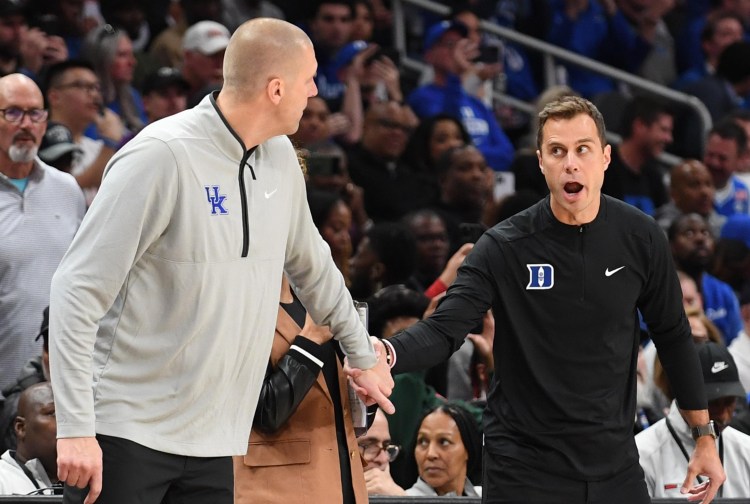
College basketball’s “blue-blood” label is one of the most debated terms in the sport, often reserved for programs with decades of sustained dominance, championship pedigree, elite recruiting pipelines, and consistent national relevance. Recently, college basketball analyst Jon Rothstein reignited that debate with a bold assessment: only Duke and UConn are currently operating at a true blue-blood level.
His stance has sparked conversation across the sport, especially among fan bases of historically elite programs that feel they belong in that conversation. But Rothstein’s argument is not about history alone—it is about present-day performance, roster construction, coaching stability, and the ability to compete for national titles every single season.
Redefining what “blue-blood” means today
Traditionally, the term “blue blood” in college basketball has included programs like North Carolina, Kansas, Kentucky, Duke, Indiana, and UCLA. These schools have combined for dozens of national championships, legendary coaches, and NBA pipeline dominance over decades.
However, Rothstein’s modern interpretation focuses less on historical legacy and more on current competitive consistency. In today’s era of transfer portals, NIL deals, and rapid roster turnover, maintaining elite status year after year has become more difficult than ever.
From his perspective, only two programs have adapted flawlessly to this new landscape: Duke and UConn.
Duke’s continued elite identity
Duke remains one of the clearest examples of sustained excellence in modern college basketball. Under legendary coach Mike Krzyzewski for decades and now under Jon Scheyer, the program has maintained its recruiting dominance, landing elite high school prospects and top-tier transfers while consistently competing in the NCAA Tournament’s later rounds.
What separates Duke, according to Rothstein’s view, is its ability to transition between eras without losing identity. Even after the retirement of Coach K, the program has not slipped into mediocrity or rebuilding uncertainty. Instead, it has remained firmly in the national title conversation.
Duke’s combination of elite facilities, national brand recognition, NBA development reputation, and recruiting reach keeps it in constant contention. Few programs can match its ability to reload talent rather than rebuild from scratch.
UConn’s championship resurgence
On the other side of the conversation stands UConn, a program that has reasserted itself as a modern powerhouse. The Huskies, led by head coach Dan Hurley, have turned recent seasons into a statement of dominance, especially in postseason play.
What makes UConn unique is its recent championship success paired with a strong program culture. While some traditional powers have experienced inconsistency, UConn has delivered at the highest level when it matters most—winning national titles and asserting itself as the team to beat in March.
Rothstein’s argument places significant weight on this recent dominance. In his view, sustained excellence is not just about regular-season rankings—it is about closing the deal in the NCAA Tournament, where legacies are truly defined.
Why other blue-bloods are being questioned
Programs like Kentucky, Kansas, North Carolina, and others still carry enormous historical weight. However, Rothstein’s position suggests that recent inconsistencies prevent them from currently being classified in the same operational tier as Duke and UConn.
For example:
Kentucky has experienced roster instability and uneven tournament results in recent seasons.
Kansas remains highly competitive but has faced early exits and fluctuating roster continuity.
North Carolina has shown flashes of elite play but has also endured seasons of inconsistency by its high standards.
These programs are still elite by most measures, but Rothstein’s argument centers on sustained, year-to-year dominance rather than legacy alone.
The impact of the transfer portal and NIL era
A major factor behind this shifting hierarchy is the modern college basketball environment. The transfer portal and NIL (Name, Image, and Likeness) deals have dramatically changed how rosters are built and maintained.
Programs can no longer rely solely on freshmen development pipelines. Instead, they must continuously retool their rosters while maintaining chemistry and competitiveness. According to Rothstein’s perspective, Duke and UConn have adapted more efficiently than others in balancing recruiting, transfers, and roster cohesion.
Duke has embraced elite recruiting while supplementing through the transfer portal when needed. UConn, meanwhile, has built a system that integrates player development with strategic roster additions, maintaining continuity even as players move on to the NBA.
Coaching stability as a defining factor
Another key element in Rothstein’s assessment is coaching stability and effectiveness. Both programs are led by coaches who have established strong systems and identities.
Duke’s transition from Mike Krzyzewski to Jon Scheyer has been surprisingly smooth, maintaining the program’s elite expectations. UConn’s Dan Hurley has built a culture of toughness, discipline, and postseason execution that has translated into championships.
In contrast, many other traditional powers have experienced coaching changes or inconsistent philosophical direction, which has impacted long-term performance.
What this means for college basketball
If Rothstein’s evaluation is accepted, it signals a shift in how the sport views elite status. Instead of relying solely on historical greatness, the definition of a blue-blood program becomes more fluid—based on current dominance, adaptability, and championship execution.
It also raises the stakes for other major programs. Schools like Kentucky, Kansas, and North Carolina are still recruiting at elite levels, but the expectation now is not just to be good—it is to maintain uninterrupted excellence in a rapidly changing sport.
Final thoughts
The debate over blue-blood status will likely continue for years, especially as college basketball evolves. While tradition remains important, the modern era demands consistent excellence in real time.
For now, according to Jon Rothstein, only Duke and UConn meet that standard. Whether other historic programs reclaim that status in the coming seasons will depend on how well they adapt to the changing landscape of college basketball.
Leave a Reply