
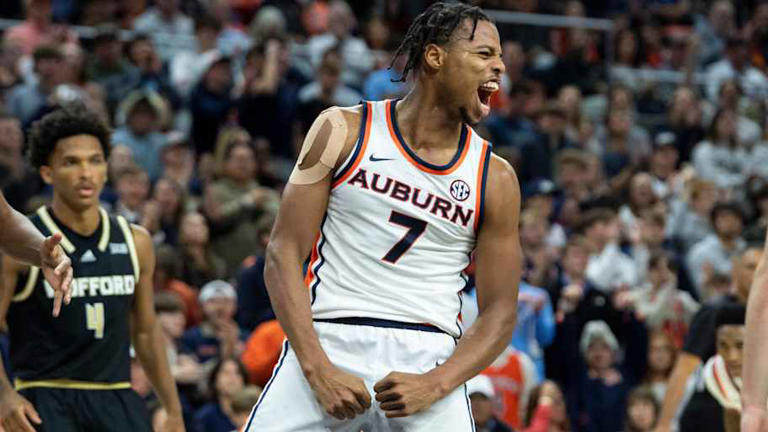
Auburn basketball has found itself at the center of discussion after reports emerged that forward Keyshawn Hall has turned down an invitation to the NBA Draft Combine. The decision has sparked debate among analysts and fans, especially given how significant the combine is for players hoping to boost their draft stock. While invitations are typically seen as a major opportunity, Hall’s choice suggests a more calculated long-term strategy rather than a straightforward rejection of the NBA pathway.
Keyshawn Hall, who transferred into Auburn with expectations of becoming one of the team’s key frontcourt contributors, is viewed as a developing forward with potential to grow into a professional-level talent. However, instead of immediately testing himself against other top prospects at the combine, he has reportedly opted to withdraw from consideration for this year’s event. That decision naturally raises the question: why would a promising forward turn down such a valuable platform?
One of the most widely discussed reasons is draft stock evaluation. The NBA Draft Combine is designed to measure a player’s readiness through athletic testing, scrimmages, interviews, and medical evaluations. For players who are not projected as guaranteed first-round picks, the combine can be a double-edged sword. A poor performance in drills or scrimmages can negatively affect perception. In Hall’s case, sources around college basketball suggest he may not currently have a secure draft projection that would benefit from public evaluation. By stepping away, he avoids the risk of hurting his stock and instead preserves the option to develop further before entering the draft at a stronger position.
Another major factor likely influencing the decision is the possibility of returning to college basketball for another season. With the rise of NIL (Name, Image, and Likeness) opportunities, many college athletes are no longer financially pressured to leave early for the professional ranks. At Auburn, Hall is positioned within a program that offers national exposure, strong competition in the SEC, and significant developmental resources. By staying in college, he could refine his skill set, improve consistency, and potentially increase his draft value in a more controlled environment rather than rushing into the professional spotlight.
Injury management and physical readiness may also be part of the equation. The NBA Combine is an intense event that includes athletic testing such as sprint drills, vertical leaps, strength assessments, and full-contact scrimmages. For players managing minor injuries or looking to improve conditioning, participating too early can pose risks. Even if not publicly confirmed, it is common for college athletes in similar situations to prioritize recovery and offseason training over exposure events. Hall’s camp may have determined that additional physical preparation is more beneficial than immediate evaluation.
A third reason could be related to feedback from NBA scouts and advisors. In modern basketball, players frequently receive advisory projections about where they might be selected if they declare for the draft. If Hall received feedback indicating he would likely fall into the second round or potentially go undrafted, it may have influenced his decision. Many players in that position choose to return to college basketball, where they can work on specific weaknesses such as shooting consistency, defensive versatility, or decision-making under pressure.
Another important element is development within Auburn’s system. Auburn has built a reputation in recent years as a program that prepares players for professional basketball through structured coaching, competitive scheduling, and physical development programs. Hall may believe that another season under Auburn’s coaching staff would allow him to expand his offensive role, improve his defensive metrics, and become a more complete forward. Instead of being evaluated in a short combine window, he would have an entire season to demonstrate growth against top-tier SEC competition.
There is also the factor of timing and personal readiness. Declaring for the draft and participating in the combine is not only a physical decision but also a mental one. The transition from college to professional basketball involves interviews with multiple franchises, media scrutiny, and pressure to perform consistently in front of scouts. Some players prefer to delay that process until they feel fully prepared to handle both the basketball and business sides of the NBA. Hall’s decision could reflect a desire to mature further before stepping into that environment.
Team dynamics at Auburn may also play a subtle role. If Hall is expected to take on a larger leadership role or increased usage next season, that responsibility could enhance his visibility and statistics significantly. Players often recognize that breakout seasons in college can dramatically improve draft positioning. Rather than entering the combine now as a developing prospect, Hall may be positioning himself to enter next year’s draft conversation as a proven star rather than a project player.
Additionally, the modern NBA draft landscape places heavy emphasis on efficiency, versatility, and consistency over isolated athletic testing. Players who leave college too early sometimes struggle to demonstrate refined skill sets. By delaying his entry, Hall has the opportunity to build a stronger résumé that includes improved shooting percentages, defensive matchups against elite opponents, and leadership experience—factors that NBA teams increasingly value.
In conclusion, Keyshawn Hall’s decision to turn down the NBA Draft Combine invitation is not necessarily a step away from professional aspirations, but rather a strategic pause. Whether driven by draft stock considerations, development goals, injury management, or advice from mentors, the move suggests a long-term vision for his basketball career. For Auburn, it means retaining a promising forward who still has room to grow. For Hall, it could be the foundation for a stronger, more confident entry into the NBA in the future—one built not on rushing the process, but on maximizing it.
Leave a Reply