
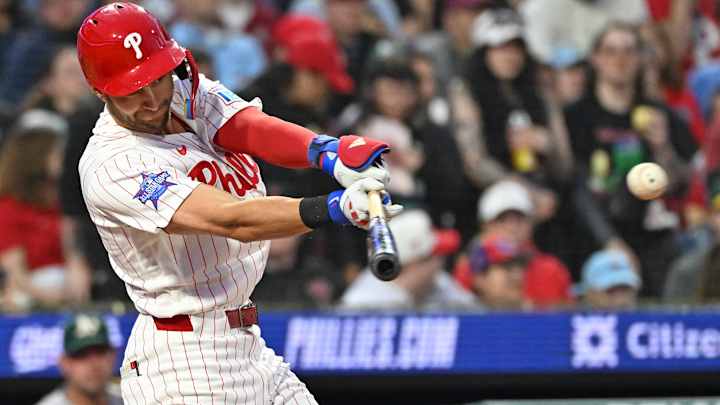
The Philadelphia Phillies enter the season with expectations that match their recent status as one of the National League’s most competitive teams. Yet, beneath the surface of strong pitching depth and star-powered left-handed production, a recurring concern continues to stand out: inconsistency from right-handed hitters in key offensive situations. Former MLB All-Star and coach Don Mattingly has often emphasized the importance of balance in a lineup, and this Phillies roster appears to be leaning too heavily in one direction when it matters most.
For the Philadelphia Phillies, the issue is not that their right-handed hitters lack talent. Instead, the problem lies in situational execution—specifically with runners in scoring position, late-inning at-bats, and matchups against elite right-handed pitching. In those moments, offensive production tends to dip, and the lineup becomes more predictable for opposing managers.
The imbalance in lineup production
The Phillies’ offensive structure is built around several elite left-handed and switch hitters who consistently drive power and on-base production. However, when opposing teams deploy right-handed pitchers—especially in playoff-style matchups—the Phillies’ offense can become segmented. Pitchers are able to attack weaker right-handed bats without fear of extended damage, forcing the left-handed core to carry an outsized burden.
Mattingly has long spoken about the importance of “lineup neutrality,” meaning a team should not dramatically shift in effectiveness based on the handedness of the opposing pitcher. For Philadelphia, that neutrality is not yet present. Their right-handed hitters often post lower averages with runners in scoring position compared to league averages, and that gap becomes more visible in high-leverage postseason environments.
Situational hitting: the key area of concern
The phrase “key area” in this discussion largely refers to situational hitting—execution with runners on base, advancing runners, and producing contact when power is not required. The Phillies have shown flashes of strength in these areas, but inconsistency remains their biggest obstacle.
Too often, right-handed hitters on the roster fall into predictable patterns: chasing breaking balls away, striking out in neutral counts, or failing to adjust mid-game when pitchers begin exploiting weaknesses. These issues are magnified in October baseball, where one missed opportunity can shift an entire series.
Mattingly’s hitting philosophy has always centered on adaptability. He has repeatedly emphasized that hitters must shrink their approach in key moments—prioritizing contact, using the opposite field when needed, and refusing to expand the strike zone under pressure. These are exactly the areas where Philadelphia’s right-handed production must improve.
Pitch recognition and plate discipline issues
Another concern for the Phillies is pitch recognition. Against elite breaking balls, particularly sliders and sweepers from right-handed pitchers, several Phillies hitters struggle to maintain consistent contact rates. This leads to deeper counts, more strikeouts, and fewer balls in play that can advance runners.
The modern MLB game heavily rewards pitchers who can tunnel fastballs and breaking pitches off the same release point. Without strong pitch recognition, even talented hitters become reactive rather than proactive. That reactive approach is one of the biggest reasons Philadelphia’s right-handed bats struggle in high-pressure at-bats.
Improving this area does not necessarily require a complete swing overhaul. Instead, it requires refined preparation—video study, early-count aggression on fastballs, and a willingness to simplify approach with runners in scoring position.
The postseason reality
In the postseason, weaknesses are exposed quickly. Opposing teams shorten rotations, rely heavily on high-leverage relievers, and exploit matchups ruthlessly. If a lineup is top-heavy or predictable, it becomes significantly easier to navigate.
For the Phillies, this means their right-handed hitters will often be targeted by elite bullpen arms late in games. Without consistent production in those matchups, opposing teams can pitch around the left-handed core more effectively.
Mattingly’s experience as both a player and coach reinforces this reality. Teams that win deep in October are not always the most powerful—they are often the most adaptable. They find ways to produce runs without relying solely on home runs or favorable matchups.
Internal solutions vs external changes
The Phillies have two paths to address this issue: internal development or external acquisition. Internally, they can focus on refining the approach of current right-handed hitters, emphasizing situational drills, and improving two-strike hitting. Coaches can also work on shortening swings and reinforcing gap-to-gap contact rather than all-or-nothing power attempts.
Externally, the front office could explore trades or free-agent signings that bring in more balanced right-handed bats with strong on-base skills. Players who can consistently handle breaking pitches and contribute in multiple spots of the lineup would immediately stabilize late-game scenarios.
However, roster changes alone do not solve the underlying issue. The culture of situational hitting must be reinforced throughout the organization, from spring training through postseason preparation.
The Mattingly blueprint
Mattingly’s influence on hitting philosophy across MLB has been significant. His approach emphasizes simplicity under pressure: see the ball early, stay through the middle of the field, and adjust only when necessary. For Phillies right-handed hitters, adopting this mindset could be the difference between streaky production and consistent reliability.
He has often argued that hitters do not need to reinvent themselves in high-leverage situations—they simply need to reduce complexity. That message resonates strongly with teams like Philadelphia, where raw talent is not in question, but execution often fluctuates.
Conclusion
The Phillies remain a legitimate contender, but their margin for error is thin. The imbalance in right-handed production, particularly in key offensive situations, is a flaw that opposing teams will continue to exploit unless addressed.
If Philadelphia can improve situational hitting from the right side of the plate—through better pitch recognition, disciplined approach, and consistent execution—they will transform from a dangerous contender into a complete postseason threat.
As Don Mattingly’s hitting philosophy suggests, success in baseball’s biggest moments is rarely about doing more. It is about doing the simple things better, under the highest pressure. For the Phillies, that lesson may define their season.
Leave a Reply